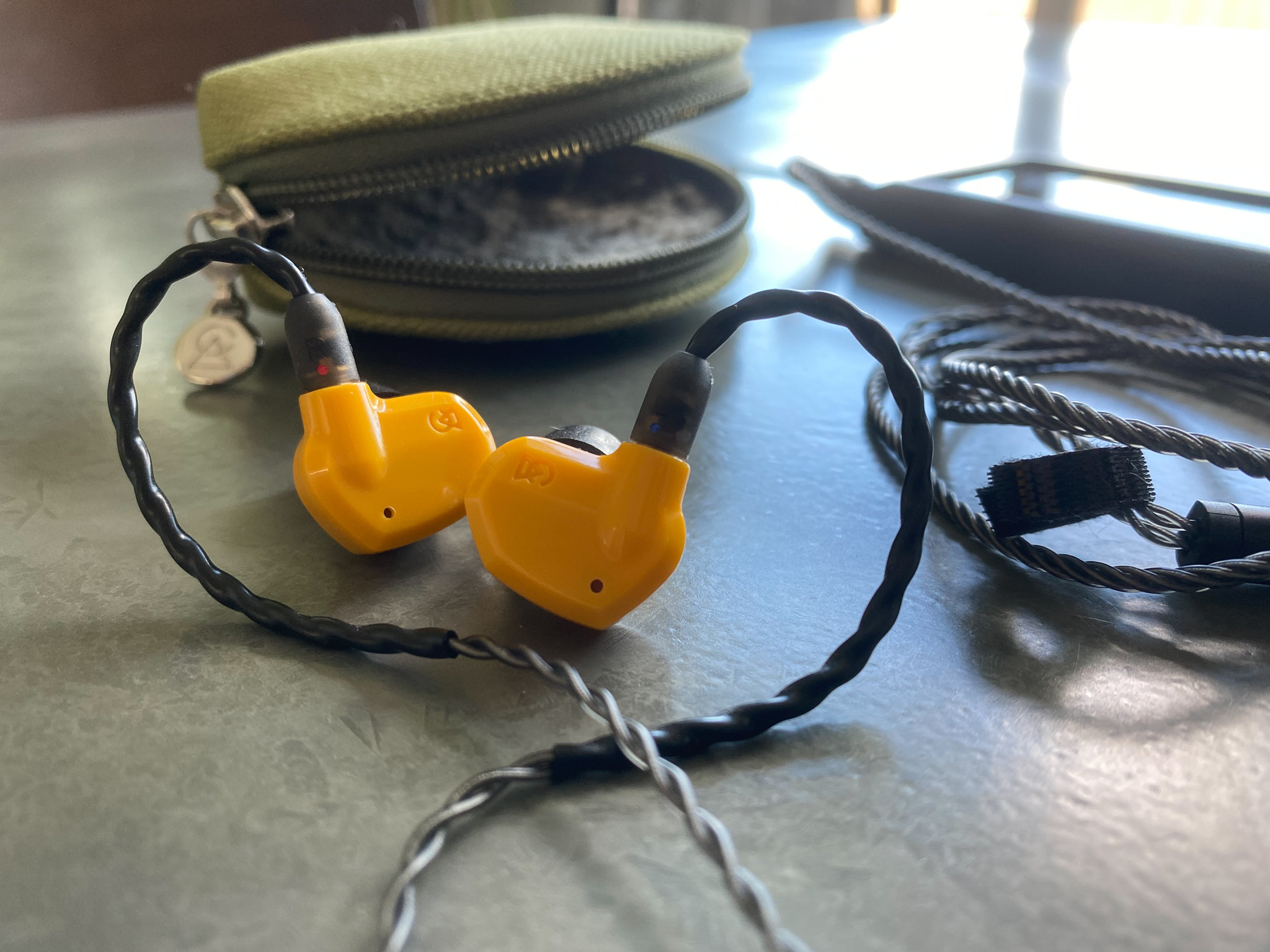
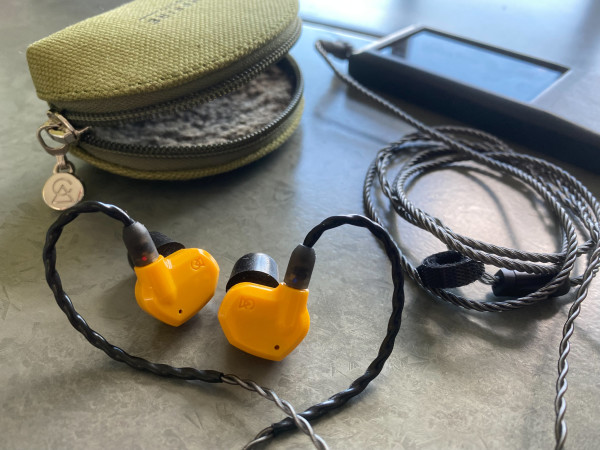
The first thing you will notice about the Campfire Audio Honeydew in-ear monitors is the fantastic color and superb design. The bud itself is a cool yellowish-orange that pops alongside the sleek, smoky Litz cable, giving these headphones an exotic sports car aesthetic.
If you are not familiar with Campfire Audio, they are more known for higher-end audiophile headphones, so it’s nice to see them entering the more price point driven market and still bringing exceptional quality and bang for the buck.
Two new models were introduced, the Satsuma ($199) and the Honeydew ($249), with the Honeydew being focused more on the bass-heavy side of the spectrum.
Opening the Box
Campfire Audio has a very cool design sensibility; you might say it’s very Portland – which is where they are based. Did they put a bird on it? (Portlandia fans, anyone?) Well, not exactly, but the box is designed with a cosmic take-out box feel; it’s funky and fun – not serious and dark like most audiophile headphones. The packaging is also very eco-friendly, with mostly cardboard construction to recycle it once you are fully committed.
Once you get the box folded open, you will find a dope little carrying case, the MMCX Litz cable, various tips and individual soft sacks for each bud, and one for the tips.
What’s in the box
- 1x set of buds
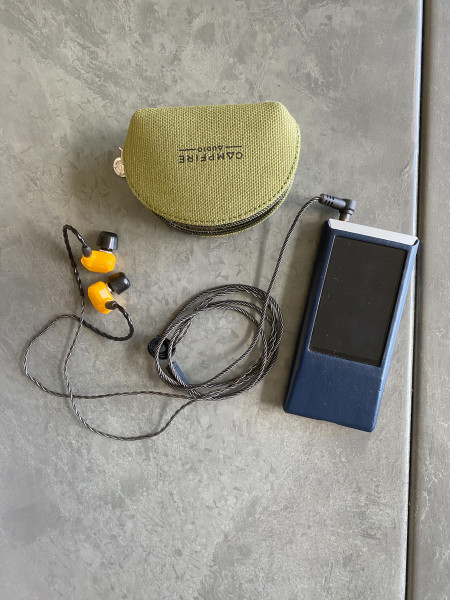
- 1x Campfire Audio Vine Green Canvas Earphone Case. Made in Portugal.
- 1x Campfire Audio Smoky Lite Litz Cable – Silver Plated Copper Conductors with Berylium Copper MMCX and 3.5mm Stereo Plug
- Final Audio Tips (xs/s/m/l/xl) – Campfire Audio Earphone Tips(s/m/l) – Silicon Earphone Tips (s/m/l) – Campfire Audio Lapel Pin – Cleaning Too
Design, Build Quality, and Comfort
The Honeydew is a new design for Campfire with a much size and weight than other IE headphones. Campfire introduces a new shell design with the Honeydew. The ‘mellow-yellow’ color, as they call it, reminds us of something from the 80s or early 90s, and it’s refreshing to see such a bold choice. The buds fit nicely into your ears, and the Litz cable wraps around your outer ear to help keep it stable. The headphones feature a stainless steel end piece where you place one of the various included tips along with beryllium MMCX connectors. So overall, the build quality for these headphones is fantastic for the price point; nothing feels cheap.
It was easy to find the right seal with the various tips, and once the Honeydews are in place, they almost disappear because they are so light and ergonomic.
The only thing that you don’t get is a microphone or any remote function; these IEMs are all about sound. So no taking phone calls on these, which might deter many commuters and creative professionals who need this functionality.

How Do They Sound?
The shell of the Honeydew features a 10mm dynamic driver, which helps bring a rich, full bottom end to these little 3D printed mellow yellow nuggets. The Litz cable (see definition below) is also standard on the Honeydew and helps with sound quality as well, depending on your source, of course.
Litz wire is a particular type of multistrand wire or cable used in electronics to carry alternating current at radio frequencies. The wire is designed to reduce the skin effect and proximity effect losses in conductors used at frequencies up to about 1 MHz. Wikipedia
We tested these buds with our faithful Astell&Kern AKjr HD audio player and found the output to be pretty phenomenal. These are low impedance headphones, so using them with laptops, iPhones, etc., is no problem and should allow plenty of volume.
As usual, we played various genres from jazz to indie to hip hop to rock and found the Honeydews to be quite solid with all of them, especially with the lower end, which is what this model was designed to do. The soundstage was also impressive for a small pair of closed-back headphones; they never feel cramped and feel bigger and broader than expected, making genres like electronic and hip hop incredibly immersive.
The low end is what the Honeydew is all about, and Campfire has labeled it as such. The mids and highs play nicely but at times really take a back seat to the bass, with the mids often getting muddy with complex jazz and the highs not quite at full sparkle. It all comes down to genre with these headphones; if you are an electronic / hip hop fan, then you will be in love with them. For fans of more nuanced music, such as math rock, jazz, classical – these might be a miss for you.
Summary
If you are a music fan who loves genres like electronic, hip hop, reggae, and other bottom-heavy music, these were designed for you. They are affordable and deliver a high-quality build and sound, giving you some of the best bang for your buck in the IEM category below $300.
Yeahs, and Mehs.
Yeahs: Great sound for bass-heavy music, comfortable and light, impressive sound stage, quality carrying case, and great price ($250)
Mehs: No mic or remote, not great for all genres, the cable can get easily tangled.
More info HERE / MSRP $249.00

David Ireland is a professional strategist, creative, and marketer. He began his career in 1995 as creator and publisher of BPM Magazine. In August 2000, BPM Magazine merged with djmixed.com LLC, an online media company based in Los Angeles, which later evolved into the Overamerica Media Group [OMG] in 2003. In 2009, Ireland left Overamerica Media Group to serve as the VP of Marketing at Diesel. In 2011, he returned to his roots in media and cofounded the online electronic music publication Magnetic Magazine and created The Magnetic Agency Group. In June 2018, Ireland joined Winter Music Conference (now owned by Ultra Music Festival) as the Director to lead the reboot for 2019 and usher in a new era for the iconic brand. He served as Chief Marketing Officer at Victrola for three years, guiding product innovation and brand growth. He currently serves on the advisory board of Audiopool, a new music tech startup focused on AI-generated music licensing and artist revenue models.