Polyend Play has been out for a while now, and we wanted to get our hands on this small and travel-friendly groovebox to see how it measures up against other devices on the market. And when it comes to grooveboxes, music producers are by no means left without options these days; so much so, that it can be hard to know which one is right for you and your setup.
We were sent a review unit of the Play by the team at Polyend, and after using the device extensively for a month or more, we quickly found that there is way more to this humble device that meets the eye (and even than what it’s advertised as being).
So let’s get into your deep and comprehensive review of the Polyend Play before making the ultimate decision on whether or not this smaller-than-you’d-expect groovebox is right for you.
Learn More About The Polyend Play While Supporting Our Small Team Of Writers Through Our Partnership With Sweetwater Here
What Is The Polyend Play?
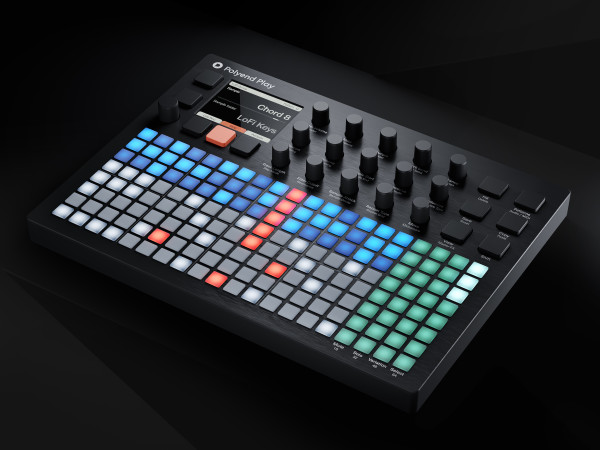
The Polyend Play is a sample-based groovebox and powerful MIDI sequencer that offers a ton of functionality and versatility in a light and travel-friendly little device.
Built as a follow-up to Polyend’s Tracker unit that was released a few years ago, which has built up a small and cult-like following in its own right, the Play’s main power, and usage lies in the 8 x 20 grid of soft pads which one uses to sequence, manipulate, and affect the samples from the Play’s internal SD card. From there, the Play offers a multitude of various ways to affect the sequence, from randomization to probability differentials and everything in between.
And while the Play has no direct audio input that allows for onboard sampling, unlike its Tracker cousin, and is an issue I will discuss a bit later on, the myriad of samples that come loaded offer producers an almost infinite number of options when programming and performing their music.
Where Tracker was a more production-based unit, at least in my opinion, Play offers the other side of the coin and doubles down on being an all-powerful MIDI sequencer. As a result, it brings so much more to the table than even it knows sometimes. But that’s a topic best saved for a full section here in a moment.
Groovebox vs. Drum Machine: What’s The Difference?
At its core, “Groovebox” is just a marketing buzzword developed and implemented in the mid-90s designed to describe a device that is a drum machine with extra bells and whistles (predominantly a couple of other instruments or sample triggers). The buzzword seems to have lingered and stuck though, as countless grooveboxes have hit the market since the term was coined almost three decades ago.
Essentially, grooveboxes are small and self-contained devices that allow you to compose and craft entire pieces of music all within the device. This is different, to a degree, from conventional drum machines.
Drum machines are devices specifically designed to synthesize, sequence, and play percussive sounds. They rely on internal hardware, analog circuits, digital audio, and more to produce the sounds. While some drum machines have tonal percussive hits that may border on something musical, they are first and foremost percussive instruments.
My Favorite Features On The Polyend Play

After having the Polyend Play in my studio for the last month and really getting an opportunity to get my hands dirty with this device, I found a ton of things that I was really impressed by. And while there could easily be a laundry list of standout features to talk about in a premium-tier device like this, here are the top four things that stood out when using the Polyend Play.
It’s Fast
I mentioned this before, but the Polyend Play doubles down on the fact that it’s a sequencer above all things. This means that all of its design to razor focused on being able to program and produce beats and pieces of music fast and efficiently. And to this point, it exceeded my expectations to the fullest.
The workflow is streamlined and straightforward and only requires a bit of light menu diving when searching for sounds and samples to use in the sequencer.
From there, tracking automation and recording in the patterns you want to play was about as easy as you could ask for. The Polyend Play allows you to get useable results with just a few clips and. button pushes, which is exactly what you need when you’re either jamming in your studio or performing live.
It’s A Main Brain Of Live Performance
Polyend Play allows you to play polyphonic chords on each MIDI track, which essentially translates to allowing you to play up to 30 overlapping notes at a single time on each track per clip. While this is an impressive stat in its own right, the creative potential for sequencing external gear via the Play is through the roof.
It might take a little bit of assistance from other gear like the Polyend Tracker or Elektron’s Octotrack, but I feel it would be easy enough to use the Play as a master sequencer for live performances; sequencing upwards of 20 or more synths simultaneously through this single device.
Throw in the potential to do crazy generative rhythmic sequencing, Euclidean rhythms, and more.
Its Effects
The Polyend Play comes stocked with a ton of quality and inspiring effects that yield great-sounding results quickly and often on the fly, and the sequencing power of the Polyend Play allows for highly-customizable steps; such as programming the send levels of delays and reverbs for each step of the pattern.
From a production standpoint, you have a suite of tools that will help you shape and tone the samples and sounds from the device. Tools like Saturation and EQs can help adjust the tones to your liking and help gel the tracks together into a single cohesive piece of music. Oftentimes with grooveboxes like this, the unit comes with thousands of cool stock samples to use but little to no tools that can help the sounds blend together. But with the Play, the effect tools help you get more than what you see right out of the box.
From a performance standpoint, the Play has almost everything you need to put together raucous live sets with ease. It has tricked-out tools like stutters, rolls, and pitch shifts that add a new level of excitement to your loops and also has DJ-like reverb and EQ effects to help seamlessly blend together tracks and ideas.
What I Wasn’t Too Crazy About
But with a device that tries to do it all, there will always be some obvious shortcomings. After messing around with the Play for the better part of a few weeks, here are some of the gripes I saw that could be improved upon.
No Onboard Sampling
Without any inputs on the Play, there is no way to sample directly into the device which I can see is a serious deterrent to many would-be users. There are other devices on the market currently around this price point that will offer onboard sampling, with additional sample-manipulation tools like more advanced ADSR envelopes and LFOs.
That being said, the device more than makes up for this specific shortcoming, at least in my humble opinion, but hosting a vast wealth of its own samples directly on the host SD card. But that in and of itself brings up my other hesitation…
It Has A Specific Sound
With most grooveboxes and all-inclusive machines (like the Syntakt), the unit has a very specific sound that many often describe as a more modern take on dub techno and other minimal-dance genres. While many producers would consider this to be the device’s biggest claim to fame, it might deter others who are looking to use the Play as an integral part of their unique signature sound in their productions.
This gripe has the potential to be offset though, as the Play does allow you to bring your own samples into the device on its SD drive. But this alone is made a bit more of a chore than I would have liked. Here’s why.
Firstly because it’s impossible to transfer and load samples into the Play directly over a USB drive. You need to load them onto the SD drive in order for them to make it onto the Play. This adds a small extra step which could be more than a light annoyance for some.
Secondly, while the Play has the potential to use other samples from your library, the biggest benefits and most heavy-hitting features of this device come from very specific mapping and folder hierarchy that the developers have painstakingly done with the stock sounds which will not be in place with your own samples. Things like sample randomization, swapping like-sounding samples, and others sound absolutely amazing when done with the stock sounds but might not be as slick when you use your vast folders of uploaded samples.
Should You Buy The Polyend Play?
Now comes the time for the big old question; should you buy this unit?
This is always a tough question to answer, made especially more difficult because of how much functionality this specific device can bring to the table; dependent on your needs as a producer and performer of course.
Overall though, the Play offers a lot of bang for your buck. It’s a great device for jamming while you’re traveling, it’s a masterful tool for sequencing larger modular rigs, and it’s a phenomenal sketch pad for cranking out unique grooves and ideas quickly and efficiently. Sure, the price tag is still expensive for anyone pinching pennies, but in the long term, this thing is a worthwhile investment for producers at any level.
And don’t take only my word for it. The Polyend Tracker, which was released just a couple of years ago, has quickly built up a cult following and devoted fanbase. And seeing at the Play is the natural evolution of the device, time is the only thing separating the Play from possessing a cult following all its own.
Learn More About The Polyend Play While Supporting Our Small Team Of Writers Through Our Partnership With Sweetwater Here
Specs On The Polyend Play
- Type: Beat Production Workstation
- Screen: Split-screen DIsplay
- Pads: 128 x Backlit SIlicone Sequencer Pads, 32 x Function Pads
- Other Controllers: 15 x Touch-capacitive knobs
- Sounds: Over 3000 Preloaded Samples
- Polyphony: 8-voice
- Sequencer: 16-track, 64-steps, 128 patterns
- Sampling: Playback, WAV, 16-bit/44.1kHz, mono, 6 minutes per project
- Effects: Reverb, Delay, Limiter, Saturator, Sound Enhancer
- Analog Outputs: 1 x 1/8″
- MIDI I/O: 2 x 1/8″ TRS Type B (in, out), USB
- USB: 1 x USB-C
- Storage: microSD Card Slot (16GB card included)
- Power Source: USB bus powered / 5V USB power adapter (included)
- Height: 1.3″
- Width: 11.02″
- Depth: 8.15″
- Weight: 2.65 lbs.
Favorite Videos Of The Polyend Play

Will Vance is a professional music producer who has been involved in the industry for the better part of a decade and has been the managing editor at Magnetic Magazine since mid-2022. In that time period, he has published thousands of articles on music production, industry think pieces and educational articles about the music industry. Over the last decade as a professional music producer, Will Vance has also ran multiple successful and highly respected record labels in the industry, including Where The Heart Is Records as well as having launched a new label with a focus on community through Magnetic Magazine. When not running these labels or producing his own music, Vance is likely writing for other top industry sites like Waves or the Hyperbits Masterclass or working on his upcoming book on mindfulness in music production. On the rare chance he's not thinking about music production, he's probably running a game of Dungeons and Dragons with his friends which he has been the dungeon master for for many years.







![How It Was Made: Low Steppa & Roel – Dreamliner [Low Trax]](https://magneticmag.com/wp-content/uploads/2026/09/DSC07195-1024x608.jpg)